> ## Documentation Index
> Fetch the complete documentation index at: https://docs.apiyi.com/llms.txt
> Use this file to discover all available pages before exploring further.
# Claude Effort & Thinking Guide
> How to correctly use output_config.effort and adaptive thinking in the Anthropic native format, with full runnable examples.
This page covers how to call Claude with the **Anthropic native Messages API** (routed through the APIYI gateway to AWS Bedrock), and the correct usage of `output_config.effort` (effort level) and `thinking` (adaptive thinking).
For channels, billing, and basic onboarding, see the [Claude API Basics](/en/api-capabilities/claude) page first.
Applicable models: Claude Opus 4.8 / 4.7 / 4.6, Sonnet 4.6, etc. This page uses **Opus 4.8** as the example.
## Online testing tool
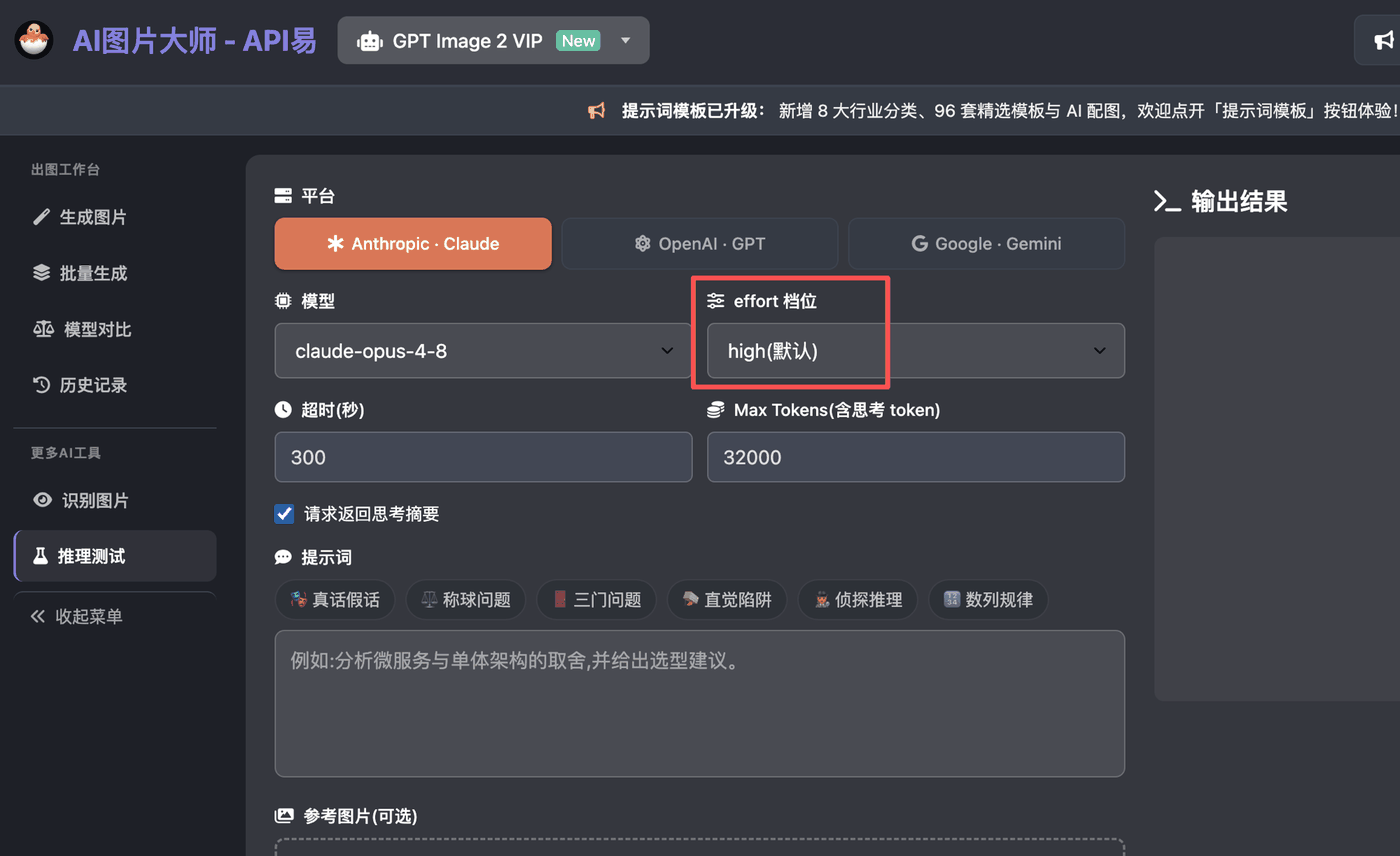
Don't want to write code? Try the APIYI online reasoning tester first: pick a model and an effort level, set Max Tokens, check "return thinking summary", and compare how each effort level reasons — right in the browser.
Run Claude (plus GPT / Gemini) reasoning tests directly in the browser — no code required, just paste your APIYI key.
 ## Request structure
### Endpoint and headers
```
POST https://api.apiyi.com/v1/messages
```
| Header | Value | Notes |
| ------------------- | ------------------ | ----------------------------------------- |
| `content-type` | `application/json` | Fixed |
| `anthropic-version` | `2023-06-01` | Anthropic native version header, required |
| `x-api-key` | `your-apiyi-key` | Anthropic native auth |
When APIYI routes to Bedrock, **the client still uses the Anthropic native format** (`x-api-key` + `/v1/messages`); the gateway handles translation to Bedrock's `bedrock-2023-05-31` internally. You do **not** need to set `anthropic_version: bedrock-2023-05-31`.
### Minimal request body
```json theme={null}
{
"model": "claude-opus-4-8",
"max_tokens": 16000,
"messages": [
{ "role": "user", "content": "Your question" }
]
}
```
## effort levels
`effort` controls how many tokens Claude is willing to spend to produce a result, trading off thoroughness against speed/cost. It affects **all** token consumption: the answer, tool calls, and extended thinking.
**Key rules**
1. `effort` must go in a top-level standalone `output_config` object — **not** inside `thinking`. Misplacing it raises a `ValidationException` / 400.
2. **No beta header needed.** Effort is now open to all supported models; `anthropic-beta: effort-2025-11-24` is no longer required.
3. The default is `high`; setting `"high"` behaves the same as omitting `effort` entirely.
### Request body with effort
```json theme={null}
{
"model": "claude-opus-4-8",
"max_tokens": 16000,
"output_config": {
"effort": "medium"
},
"messages": [
{ "role": "user", "content": "Analyze the tradeoffs of microservices vs. a monolith" }
]
}
```
### Level overview
| Level | Description | Typical use |
| -------- | --------------------------------------------------------- | ------------------------------------------------------- |
| `low` | Cheapest. Major token savings, slightly lower capability. | Simple tasks, high concurrency, sub-agents |
| `medium` | Balanced. Moderate token savings. | A reasonable default for most agentic workflows |
| `high` | Default. High capability. | Complex reasoning, hard coding, quality-sensitive tasks |
| `xhigh` | Long-horizon extended capability, between high and max. | Long coding / agentic tasks (over 30 minutes) |
| `max` | Unconstrained peak capability. | Truly frontier problems, deepest reasoning |
**Opus 4.8 recommendation**: start coding / agentic work at `xhigh`, use `high` for other intelligence-sensitive tasks, and only drop to `medium` / `low` once your evals confirm quality holds.
When running `xhigh` / `max`, set `max_tokens` high (64k as a starting point) to leave the model room for thinking + output.
### Which levels each model supports
Not every model supports every level. `xhigh` was added on Opus 4.7, and `max` is not supported on Sonnet:
| Level | Opus 4.6 | Opus 4.7 / 4.8 | Sonnet 4.6 |
| ------------------------- | :------: | :------------: | :--------: |
| `low` / `medium` / `high` | ✅ | ✅ | ✅ |
| `xhigh` | ❌ | ✅ | ❌ |
| `max` | ✅ | ✅ | ❌ |
Common mistake: `claude-opus-4-6` with `effort: "xhigh"`. Opus 4.6 has no `xhigh` level — use `high` / `max` instead, or switch the model to `claude-opus-4-8` to use `xhigh`.
## Adaptive thinking
Opus 4.7 / 4.8 use **adaptive thinking**: the model decides when and how much to think, with effort controlling depth.
```json theme={null}
{
"model": "claude-opus-4-8",
"max_tokens": 16000,
"thinking": {
"type": "adaptive",
"display": "summarized"
},
"output_config": {
"effort": "xhigh"
},
"messages": [
{ "role": "user", "content": "Walk through and pinpoint the root cause of this production bug" }
]
}
```
* `thinking.type: "adaptive"` — enables adaptive thinking (omit it and the model won't think).
* `thinking.display: "summarized"` — returns **thinking summary** blocks in the response; drop it if you don't need to surface them.
* How effort relates to thinking: `high` / `xhigh` / `max` almost always think deeply; `low` / `medium` may skip thinking on simple problems.
* The `display` default differs by model: **Opus 4.6 defaults to `summarized`**, while Opus 4.7 / 4.8 default to `omitted` (the thinking block still exists but its `thinking` text is empty, which shows up as a pause before the answer). Set `display: "summarized"` explicitly to reliably get summaries.
* There is no `-thinking` suffix model in the native API. Whether the model thinks is controlled by the `thinking` **parameter**, not a model-name suffix; any `xxx-thinking` is a third-party alias — just use the base model ID plus the `thinking` parameter.
Opus 4.7 / 4.8 do **not** support `thinking.type: "enabled"` + `budget_tokens` (it returns 400). Use adaptive + effort instead.
### What the thinking summary actually is (important)
* The summary is **generated by Anthropic (the model/serving layer)** — not the gateway and not a separate model. The raw chain of thought is never returned verbatim; what you get is the official summary.
* You **cannot style the thinking summary via the system prompt**. `system` shapes how the model *thinks* and the style of the *final answer*; the summary is just a readable rendering of internal reasoning. Put tone, formatting, and style requirements into the constraints on the **final answer** so they show up in the `text` block.
* Don't prompt the model to output its internal reasoning verbatim in the answer — it can trigger a refusal (`stop_reason: "refusal"`, with `stop_details.category` possibly `reasoning_extraction`). To see reasoning, read the `display: "summarized"` summary instead.
When continuing a multi-turn conversation **on the same model**, pass the thinking blocks from the previous turn back unchanged (including the signature and empty-text blocks) — the API rejects **modified** thinking blocks. Displaying the summary is fine; editing it before passing it back is not.
## Parsing the response
The response `content` is an array of blocks, distinguished by `type`:
```python theme={null}
for block in data["content"]:
if block["type"] == "thinking":
print("[Thinking summary]", block["thinking"])
elif block["type"] == "text":
print("[Answer]", block["text"])
```
Token usage is in the `usage` field:
```json theme={null}
{
"usage": {
"input_tokens": 164,
"output_tokens": 11056,
"service_tier": "standard"
}
}
```
If `stop_reason` is `max_tokens`, the output was truncated by `max_tokens` (thinking can easily fill the budget at high effort), and the answer text may be empty — just raise `max_tokens`.
## thinking fields under streaming (stream)
With `stream: true`, thinking content does **not** come through `delta.text` — it's a dedicated event sequence:
| Event | Field | Notes |
| --------------------- | -------------------------------------------------- | --------------------------------------------------------------------- |
| `content_block_start` | `content_block.type = "thinking"` | Thinking block starts |
| `content_block_delta` | `delta.type = "thinking_delta"` → `delta.thinking` | Incremental summary text (not `delta.text`) |
| `content_block_delta` | `delta.type = "signature_delta"` | Thinking-block signature; preserve verbatim when replaying multi-turn |
| `content_block_stop` | — | Thinking block ends; the `text` block follows |
The answer text still comes through `delta.type = "text_delta"` → `delta.text`. With `display: "omitted"`, the thinking block still appears but `delta.thinking` is an empty string.
## Full runnable example
```python theme={null}
import os
import requests
from dotenv import load_dotenv
load_dotenv()
API_KEY = os.getenv("APIYI_API_KEY")
BASE_URL = "https://api.apiyi.com"
resp = requests.post(
f"{BASE_URL}/v1/messages",
headers={
"content-type": "application/json",
"anthropic-version": "2023-06-01",
"x-api-key": API_KEY,
},
json={
"model": "claude-opus-4-8",
"max_tokens": 16000,
"thinking": {"type": "adaptive", "display": "summarized"},
"output_config": {"effort": "xhigh"},
"messages": [
{"role": "user", "content": "Analyze the tradeoffs of microservices vs. a monolith"}
],
},
timeout=300,
)
data = resp.json()
print("status:", resp.status_code, "| usage:", data.get("usage"))
for block in data.get("content", []):
if block.get("type") == "thinking":
print("\n[Thinking summary]\n", block.get("thinking", ""))
elif block.get("type") == "text":
print("\n[Answer]\n", block.get("text", ""))
```
```bash theme={null}
curl https://api.apiyi.com/v1/messages \
-H "content-type: application/json" \
-H "anthropic-version: 2023-06-01" \
-H "x-api-key: your-apiyi-key" \
-d '{
"model": "claude-opus-4-8",
"max_tokens": 16000,
"thinking": { "type": "adaptive" },
"output_config": { "effort": "xhigh" },
"messages": [{ "role": "user", "content": "Analyze the tradeoffs of microservices vs. a monolith" }]
}'
```
## Notes for the Bedrock route
| Item | Notes |
| ----------------------- | ---------------------------------------------------------------------------------------------------------------------------------------------------------------------------------------------------------------- |
| `output_config` | **Must be passed through.** If the gateway has a `delete output_config` override rule, effort gets silently dropped (returns 200 but has no effect). |
| `effort` position | Inside the top-level `output_config`, never inside `thinking`. |
| Beta header | Not needed for effort; not needed for adaptive thinking either. |
| `temperature` / `top_p` | Opus 4.7 / 4.8 with adaptive thinking should use default sampling; the gateway typically strips these two params for these models — that's expected, and the client need not set them. |
| Invalid effort values | Bedrock **degrades gracefully** on unknown values (returns 200), no 400. So you can't tell whether effort passes through by "does invalid error out" — check whether token counts diverge across levels instead. |
## Troubleshooting
### `"thinking.type.enabled" is not supported for this model`
The most common 400 when calling Opus 4.7 / 4.8 through the AWS (Bedrock) route:
```
status_code=400, InvokeModelWithResponseStream: ... Bedrock Runtime,
StatusCode: 400, ValidationException: "thinking.type.enabled" is not supported
for this model. Use "thinking.type.adaptive" and "output_config.effort" to
control thinking behavior.
```
**Cause**: the request body still uses the old fixed-budget thinking form `thinking: { "type": "enabled", "budget_tokens": N }`. Opus 4.7 / 4.8 (and newer models) have **removed** it and support adaptive thinking only; the AWS upstream returns a `ValidationException` 400. This matches the note in the [Adaptive thinking](#adaptive-thinking) section above.
The `thinking.type.enabled` in the error refers to your request's `thinking.type` field being set to `"enabled"`. Likewise `budget_tokens` is no longer supported; `temperature` / `top_p` / `top_k` are also removed on these models and will 400 if sent.
**Fix**: drop `type: "enabled"` and `budget_tokens`, and use `adaptive` + `output_config.effort` to control thinking depth.
```json theme={null}
{
"model": "claude-opus-4-8",
"max_tokens": 16000,
"thinking": { "type": "adaptive", "display": "summarized" },
"output_config": { "effort": "xhigh" },
"messages": [
{ "role": "user", "content": "Your question" }
]
}
```
| Old form (400s) | New form |
| ---------------------------------------------------------- | ------------------------------------------------------------------- |
| `"thinking": { "type": "enabled", "budget_tokens": 8000 }` | `"thinking": { "type": "adaptive" }` |
| Control thinking via `budget_tokens` | Control via `output_config.effort` (`low` – `max`) |
| `temperature` / `top_p` / `top_k` | Just remove them — steer with the prompt, no sampling params needed |
To run without thinking: Opus 4.7 / 4.8 accept `thinking: { "type": "disabled" }`, or simply omit the `thinking` field (no field = no thinking).
## References
* Anthropic — Effort docs: `platform.claude.com/docs/en/build-with-claude/effort`
* AWS Bedrock — Adaptive thinking: `docs.aws.amazon.com/bedrock/latest/userguide/claude-messages-adaptive-thinking.html`
* AWS Bedrock — Claude Opus 4.8: `docs.aws.amazon.com/bedrock/latest/userguide/model-card-anthropic-claude-opus-4-8.html`
## Request structure
### Endpoint and headers
```
POST https://api.apiyi.com/v1/messages
```
| Header | Value | Notes |
| ------------------- | ------------------ | ----------------------------------------- |
| `content-type` | `application/json` | Fixed |
| `anthropic-version` | `2023-06-01` | Anthropic native version header, required |
| `x-api-key` | `your-apiyi-key` | Anthropic native auth |
When APIYI routes to Bedrock, **the client still uses the Anthropic native format** (`x-api-key` + `/v1/messages`); the gateway handles translation to Bedrock's `bedrock-2023-05-31` internally. You do **not** need to set `anthropic_version: bedrock-2023-05-31`.
### Minimal request body
```json theme={null}
{
"model": "claude-opus-4-8",
"max_tokens": 16000,
"messages": [
{ "role": "user", "content": "Your question" }
]
}
```
## effort levels
`effort` controls how many tokens Claude is willing to spend to produce a result, trading off thoroughness against speed/cost. It affects **all** token consumption: the answer, tool calls, and extended thinking.
**Key rules**
1. `effort` must go in a top-level standalone `output_config` object — **not** inside `thinking`. Misplacing it raises a `ValidationException` / 400.
2. **No beta header needed.** Effort is now open to all supported models; `anthropic-beta: effort-2025-11-24` is no longer required.
3. The default is `high`; setting `"high"` behaves the same as omitting `effort` entirely.
### Request body with effort
```json theme={null}
{
"model": "claude-opus-4-8",
"max_tokens": 16000,
"output_config": {
"effort": "medium"
},
"messages": [
{ "role": "user", "content": "Analyze the tradeoffs of microservices vs. a monolith" }
]
}
```
### Level overview
| Level | Description | Typical use |
| -------- | --------------------------------------------------------- | ------------------------------------------------------- |
| `low` | Cheapest. Major token savings, slightly lower capability. | Simple tasks, high concurrency, sub-agents |
| `medium` | Balanced. Moderate token savings. | A reasonable default for most agentic workflows |
| `high` | Default. High capability. | Complex reasoning, hard coding, quality-sensitive tasks |
| `xhigh` | Long-horizon extended capability, between high and max. | Long coding / agentic tasks (over 30 minutes) |
| `max` | Unconstrained peak capability. | Truly frontier problems, deepest reasoning |
**Opus 4.8 recommendation**: start coding / agentic work at `xhigh`, use `high` for other intelligence-sensitive tasks, and only drop to `medium` / `low` once your evals confirm quality holds.
When running `xhigh` / `max`, set `max_tokens` high (64k as a starting point) to leave the model room for thinking + output.
### Which levels each model supports
Not every model supports every level. `xhigh` was added on Opus 4.7, and `max` is not supported on Sonnet:
| Level | Opus 4.6 | Opus 4.7 / 4.8 | Sonnet 4.6 |
| ------------------------- | :------: | :------------: | :--------: |
| `low` / `medium` / `high` | ✅ | ✅ | ✅ |
| `xhigh` | ❌ | ✅ | ❌ |
| `max` | ✅ | ✅ | ❌ |
Common mistake: `claude-opus-4-6` with `effort: "xhigh"`. Opus 4.6 has no `xhigh` level — use `high` / `max` instead, or switch the model to `claude-opus-4-8` to use `xhigh`.
## Adaptive thinking
Opus 4.7 / 4.8 use **adaptive thinking**: the model decides when and how much to think, with effort controlling depth.
```json theme={null}
{
"model": "claude-opus-4-8",
"max_tokens": 16000,
"thinking": {
"type": "adaptive",
"display": "summarized"
},
"output_config": {
"effort": "xhigh"
},
"messages": [
{ "role": "user", "content": "Walk through and pinpoint the root cause of this production bug" }
]
}
```
* `thinking.type: "adaptive"` — enables adaptive thinking (omit it and the model won't think).
* `thinking.display: "summarized"` — returns **thinking summary** blocks in the response; drop it if you don't need to surface them.
* How effort relates to thinking: `high` / `xhigh` / `max` almost always think deeply; `low` / `medium` may skip thinking on simple problems.
* The `display` default differs by model: **Opus 4.6 defaults to `summarized`**, while Opus 4.7 / 4.8 default to `omitted` (the thinking block still exists but its `thinking` text is empty, which shows up as a pause before the answer). Set `display: "summarized"` explicitly to reliably get summaries.
* There is no `-thinking` suffix model in the native API. Whether the model thinks is controlled by the `thinking` **parameter**, not a model-name suffix; any `xxx-thinking` is a third-party alias — just use the base model ID plus the `thinking` parameter.
Opus 4.7 / 4.8 do **not** support `thinking.type: "enabled"` + `budget_tokens` (it returns 400). Use adaptive + effort instead.
### What the thinking summary actually is (important)
* The summary is **generated by Anthropic (the model/serving layer)** — not the gateway and not a separate model. The raw chain of thought is never returned verbatim; what you get is the official summary.
* You **cannot style the thinking summary via the system prompt**. `system` shapes how the model *thinks* and the style of the *final answer*; the summary is just a readable rendering of internal reasoning. Put tone, formatting, and style requirements into the constraints on the **final answer** so they show up in the `text` block.
* Don't prompt the model to output its internal reasoning verbatim in the answer — it can trigger a refusal (`stop_reason: "refusal"`, with `stop_details.category` possibly `reasoning_extraction`). To see reasoning, read the `display: "summarized"` summary instead.
When continuing a multi-turn conversation **on the same model**, pass the thinking blocks from the previous turn back unchanged (including the signature and empty-text blocks) — the API rejects **modified** thinking blocks. Displaying the summary is fine; editing it before passing it back is not.
## Parsing the response
The response `content` is an array of blocks, distinguished by `type`:
```python theme={null}
for block in data["content"]:
if block["type"] == "thinking":
print("[Thinking summary]", block["thinking"])
elif block["type"] == "text":
print("[Answer]", block["text"])
```
Token usage is in the `usage` field:
```json theme={null}
{
"usage": {
"input_tokens": 164,
"output_tokens": 11056,
"service_tier": "standard"
}
}
```
If `stop_reason` is `max_tokens`, the output was truncated by `max_tokens` (thinking can easily fill the budget at high effort), and the answer text may be empty — just raise `max_tokens`.
## thinking fields under streaming (stream)
With `stream: true`, thinking content does **not** come through `delta.text` — it's a dedicated event sequence:
| Event | Field | Notes |
| --------------------- | -------------------------------------------------- | --------------------------------------------------------------------- |
| `content_block_start` | `content_block.type = "thinking"` | Thinking block starts |
| `content_block_delta` | `delta.type = "thinking_delta"` → `delta.thinking` | Incremental summary text (not `delta.text`) |
| `content_block_delta` | `delta.type = "signature_delta"` | Thinking-block signature; preserve verbatim when replaying multi-turn |
| `content_block_stop` | — | Thinking block ends; the `text` block follows |
The answer text still comes through `delta.type = "text_delta"` → `delta.text`. With `display: "omitted"`, the thinking block still appears but `delta.thinking` is an empty string.
## Full runnable example
```python theme={null}
import os
import requests
from dotenv import load_dotenv
load_dotenv()
API_KEY = os.getenv("APIYI_API_KEY")
BASE_URL = "https://api.apiyi.com"
resp = requests.post(
f"{BASE_URL}/v1/messages",
headers={
"content-type": "application/json",
"anthropic-version": "2023-06-01",
"x-api-key": API_KEY,
},
json={
"model": "claude-opus-4-8",
"max_tokens": 16000,
"thinking": {"type": "adaptive", "display": "summarized"},
"output_config": {"effort": "xhigh"},
"messages": [
{"role": "user", "content": "Analyze the tradeoffs of microservices vs. a monolith"}
],
},
timeout=300,
)
data = resp.json()
print("status:", resp.status_code, "| usage:", data.get("usage"))
for block in data.get("content", []):
if block.get("type") == "thinking":
print("\n[Thinking summary]\n", block.get("thinking", ""))
elif block.get("type") == "text":
print("\n[Answer]\n", block.get("text", ""))
```
```bash theme={null}
curl https://api.apiyi.com/v1/messages \
-H "content-type: application/json" \
-H "anthropic-version: 2023-06-01" \
-H "x-api-key: your-apiyi-key" \
-d '{
"model": "claude-opus-4-8",
"max_tokens": 16000,
"thinking": { "type": "adaptive" },
"output_config": { "effort": "xhigh" },
"messages": [{ "role": "user", "content": "Analyze the tradeoffs of microservices vs. a monolith" }]
}'
```
## Notes for the Bedrock route
| Item | Notes |
| ----------------------- | ---------------------------------------------------------------------------------------------------------------------------------------------------------------------------------------------------------------- |
| `output_config` | **Must be passed through.** If the gateway has a `delete output_config` override rule, effort gets silently dropped (returns 200 but has no effect). |
| `effort` position | Inside the top-level `output_config`, never inside `thinking`. |
| Beta header | Not needed for effort; not needed for adaptive thinking either. |
| `temperature` / `top_p` | Opus 4.7 / 4.8 with adaptive thinking should use default sampling; the gateway typically strips these two params for these models — that's expected, and the client need not set them. |
| Invalid effort values | Bedrock **degrades gracefully** on unknown values (returns 200), no 400. So you can't tell whether effort passes through by "does invalid error out" — check whether token counts diverge across levels instead. |
## Troubleshooting
### `"thinking.type.enabled" is not supported for this model`
The most common 400 when calling Opus 4.7 / 4.8 through the AWS (Bedrock) route:
```
status_code=400, InvokeModelWithResponseStream: ... Bedrock Runtime,
StatusCode: 400, ValidationException: "thinking.type.enabled" is not supported
for this model. Use "thinking.type.adaptive" and "output_config.effort" to
control thinking behavior.
```
**Cause**: the request body still uses the old fixed-budget thinking form `thinking: { "type": "enabled", "budget_tokens": N }`. Opus 4.7 / 4.8 (and newer models) have **removed** it and support adaptive thinking only; the AWS upstream returns a `ValidationException` 400. This matches the note in the [Adaptive thinking](#adaptive-thinking) section above.
The `thinking.type.enabled` in the error refers to your request's `thinking.type` field being set to `"enabled"`. Likewise `budget_tokens` is no longer supported; `temperature` / `top_p` / `top_k` are also removed on these models and will 400 if sent.
**Fix**: drop `type: "enabled"` and `budget_tokens`, and use `adaptive` + `output_config.effort` to control thinking depth.
```json theme={null}
{
"model": "claude-opus-4-8",
"max_tokens": 16000,
"thinking": { "type": "adaptive", "display": "summarized" },
"output_config": { "effort": "xhigh" },
"messages": [
{ "role": "user", "content": "Your question" }
]
}
```
| Old form (400s) | New form |
| ---------------------------------------------------------- | ------------------------------------------------------------------- |
| `"thinking": { "type": "enabled", "budget_tokens": 8000 }` | `"thinking": { "type": "adaptive" }` |
| Control thinking via `budget_tokens` | Control via `output_config.effort` (`low` – `max`) |
| `temperature` / `top_p` / `top_k` | Just remove them — steer with the prompt, no sampling params needed |
To run without thinking: Opus 4.7 / 4.8 accept `thinking: { "type": "disabled" }`, or simply omit the `thinking` field (no field = no thinking).
## References
* Anthropic — Effort docs: `platform.claude.com/docs/en/build-with-claude/effort`
* AWS Bedrock — Adaptive thinking: `docs.aws.amazon.com/bedrock/latest/userguide/claude-messages-adaptive-thinking.html`
* AWS Bedrock — Claude Opus 4.8: `docs.aws.amazon.com/bedrock/latest/userguide/model-card-anthropic-claude-opus-4-8.html`