

Short answer
APIYI now supports passkey sign-in. Once bound, logging in on a machine you use regularly takes nothing more than a fingerprint, face scan, or your device screen lock — no account password required. Where to bind: after logging in, go to Profile → scroll to the bottom → Account Options → Bind Passkey, athttps://api.apiyi.com/account/profile.
Why it is worth doing: no password to remember (forgotten passwords are by far the most common login support request), and passkeys are inherently phishing- and credential-stuffing-resistant — the private key never leaves your device or password manager, and there is no stealable password stored on the server.
What a passkey is
A passkey is passwordless sign-in built on the WebAuthn / FIDO2 standard. When you bind one, your device generates a key pair:- The private key stays in your device’s secure element or password manager and is never uploaded;
- The public key is stored by APIYI and can only verify signatures — it cannot be used to derive the private key.
No forgotten passwords
Any device with biometrics logs you in directly — no email reset flow
Phishing-resistant by design
A passkey is bound to the domain, so a look-alike site cannot trigger verification at all
Immune to credential stuffing
There is no password on the server to leak, so breaches elsewhere do not reach your account here
How to bind one
1
Open your Profile page
After signing in, go to
https://api.apiyi.com/account/profile, or click Profile in the left navigation.2
Scroll to the bottom and find Account Options
In the Account Options card at the very bottom of the page, click Bind Passkey.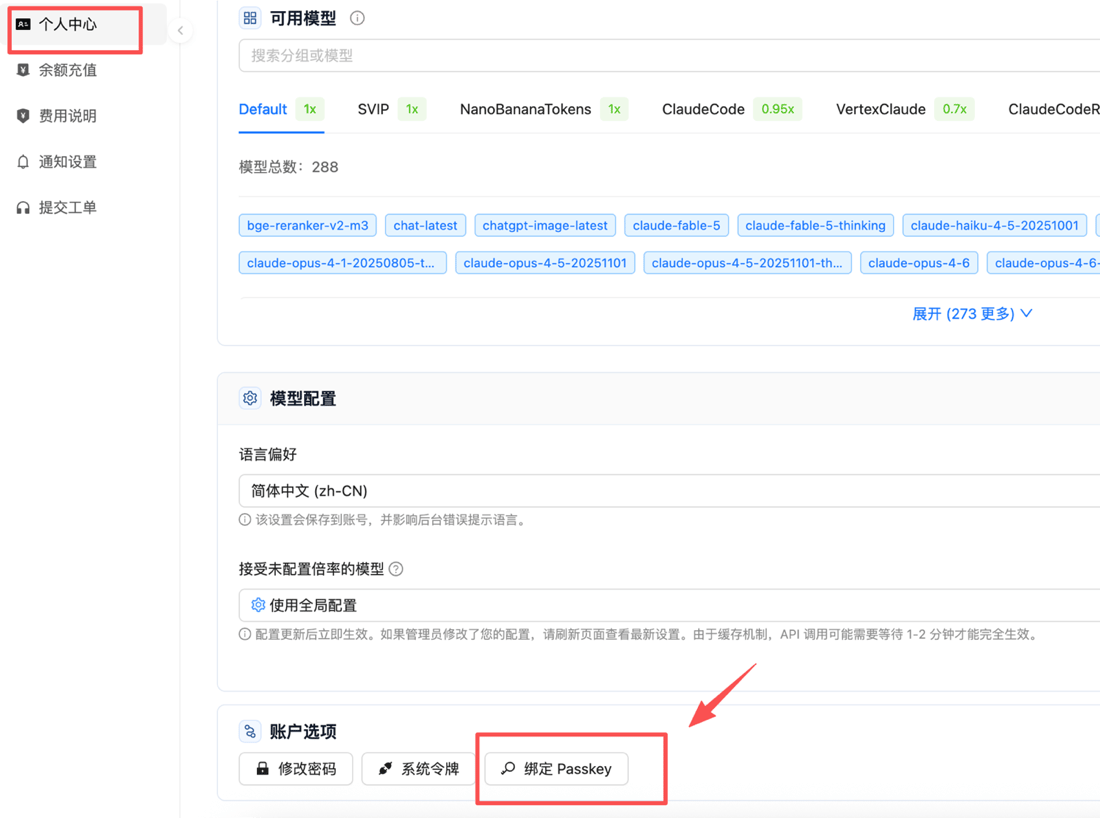
3
Choose where to save it
Your browser opens a system dialog asking where to save the passkey for apiyi.com. Pick whichever fits your setup: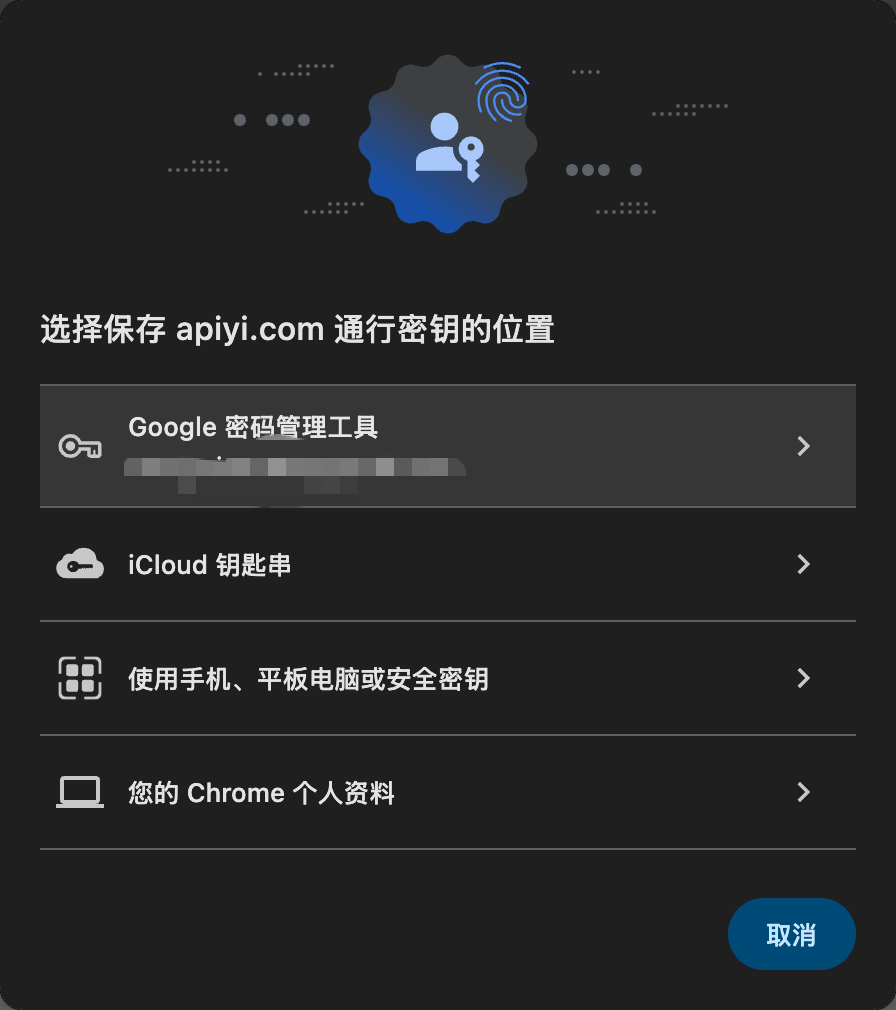
4
Verify, and you are done
Confirm with your fingerprint, face scan, or screen lock as prompted. From then on, choose passkey sign-in on the login page and one verification gets you in.
Checking status and unbinding
Once bound, return to Profile → Account Options and the button becomes Unbind Passkey, with the last used date shown next to it — a quick way to confirm whether and when your passkey was used.
Things to watch out for
- Do not bind on a shared computer: a passkey lives on the device, so binding one on a public or borrowed machine leaves sign-in capability behind on it. For temporary access, choose the “phone, tablet, or security key” option and verify by QR code on your own phone.
- Check the domain before verifying: during a legitimate bind or sign-in, the dialog shows
apiyi.com. If the domain is wrong, stop — that check is exactly how passkeys defeat phishing. - Sync depends on where you saved it: iCloud Keychain syncs across Apple devices, Google Password Manager syncs across devices, a local browser profile does not sync at all. Choose based on whether you need to sign in from multiple devices.
- A passkey is not an API key: passkeys only cover signing in to the console and have no effect on API calls. For API credential hygiene, see how to manage API keys securely.
- Browser requirements: a recent version of Chrome, Edge, Safari, or Firefox, on a device with fingerprint / face / screen-lock verification. Older browsers may not show the binding option at all.
Common questions
Can I still sign in with my password after binding a passkey?
Can I still sign in with my password after binding a passkey?
Yes. A passkey adds a sign-in method; password sign-in and GitHub sign-in keep working as before. We recommend keeping at least one fallback available.
I switched computers — does my passkey still work?
I switched computers — does my passkey still work?
It depends on where you saved it. Passkeys in iCloud Keychain or Google Password Manager sync across devices and work as soon as you sign in to that account on the new machine. One saved only in a local browser profile does not sync, so you will need to bind again on the new device.
What if I lose my phone or my device breaks?
What if I lose my phone or my device breaks?
Sign in with a fallback method (password or GitHub), unbind the old passkey from your Profile page, then bind a new one on your new device. This is precisely why we insist on keeping a backup sign-in method.
Can I bind more than one device?
Can I bind more than one device?
If the passkey is stored in iCloud Keychain or Google Password Manager, it syncs to your other devices automatically and usually needs no re-binding. To use it across ecosystems that do not sync with each other (say a Mac and an Android phone), unbind and re-bind within the other ecosystem, or use the “phone, tablet, or security key” QR flow for occasional access.
Does a passkey expose my fingerprint data?
Does a passkey expose my fingerprint data?
No. Fingerprint and face data are verified locally on your device and never sent to the site. All APIYI stores is a public key from which the private key cannot be derived.
I clicked Bind but no dialog appeared.
I clicked Bind but no dialog appeared.
Usual causes: an outdated browser, no screen lock or biometrics configured on the device, browser permissions blocking the prompt, or an embedded browser without WebAuthn support (common inside mobile apps). Switch to the latest Chrome / Edge / Safari, enable screen-lock verification in your OS, and try again.